In the world of collectible watches, few models inspire as much passion as the Omega Speedmaster Professional. Nicknamed the « Moonwatch » after being certified by NASA for all manned space missions and worn on the Moon in 1969, it has established itself as an absolute icon.
Beyond its legendary status and timeless design, one question regularly arises amongst collectors : are vintage Omega Speedmasters a good financial investment?
The answer is yes, without a doubt. In this article, we’ll analyse why the vintage Speedmaster offers an unbeatable history-to-value ratio — particularly below the symbolic €5,000 mark — and break down the market data using price trend charts.
A major milestone on the horizon : the 70th anniversary in 2027
Whilst the vintage Speedmaster market is built on solid foundations, a key event is set to act as a major catalyst : the model’s 70th anniversary in 2027.
Launched in 1957 under the reference CK 2915, the Speedmaster will soon celebrate seven decades of existence. Historically, major anniversaries of a watchmaking icon are always accompanied by a return to the limelight :
- Commemorative launches by Omega that draw the attention of the media and collectors worldwide to the brand’s heritage.
- An overall rise in demand for original models from the 1950s, 1960s and 1970s, sought after by enthusiasts keen to acquire a historic piece rather than a modern reissue.
Below, Speedmaster CK 2915 (1957). Current value : €60,000 – €100,000.

A unique historic opportunity for under €5,000
In the collectable watch market, it is almost impossible to find a model that has made its mark on history with a starting price of less than €5,000.
Let’s compare for a moment :
- A vintage Rolex Submariner or a Daytona chronograph easily costs well over ten thousand (or even several tens of thousands) of euros.
- An Audemars Piguet Royal Oak or a Patek Philippe Nautilus also fall into very high price brackets.
For under €5,000, no other watch in the world offers :
A space heritage : Certified by NASA in 1965, present on the Moon during Apollo 11, and played a vital role during the Apollo 13 mission.
A mechanical heritage : Iconic movements developed in collaboration with Lemania (the column-wheel caliber 321, followed by the legendary cam-operated caliber 861). Here, there’s no ETA caliber, unlike 90 per cent of chronographs on the market !
A design continuity : An asymmetrical case, a black tachymeter bezel and a three-sub-dial dial offering perfect legibility, which have remained virtually unchanged since 1963.
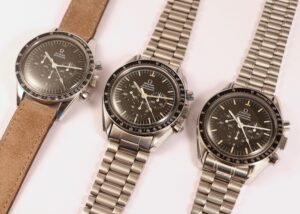
Shown below : Speedmaster 105.003 « Ed White » (1966), 145.022-69 (1970) and 3590.50 (1992).
Market analysis : How has the value of Speedmasters changed over time ?
It is not easy to establish an accurate valuation given the number of factors to take into account : the condition of the watch, whether or not it has been serviced, the beauty of the patina, and so on…
However, the charts provided by chrono24 allow us to observe a general trend. Below, we will analyse several iconic models. It should be noted, however, that « exceptional » examples – for instance, those with a chocolate-coloured dial or a bluish bezel – may be worth considerably more due to their rarity.
The Speedmaster Professional 3590.50 (« The ideal entry-level model »)
1980s–1990s, caliber 861.
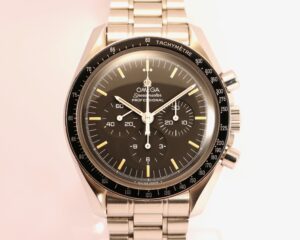
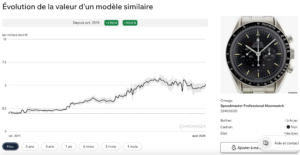
This is the perfect example to illustrate the under-€5,000 segment. In 2011, this model was trading at around €1,800. Today, it is firmly priced between €4,500 and €5,500, or even higher for examples in exceptional condition or full set.
Why this rise in value ? The 3590.50 combines the vintage patina of tritium indexes (which take on a superb eggshell or light brown colour) with the reliability of a modern watch. It is the ideal purchase for new collectors : affordable, highly liquid and showing steady long-term appreciation.
The Speedmaster Professional 105.012 (« The real Moonwatch »)
1964–1968, caliber 321.
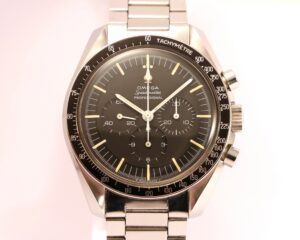
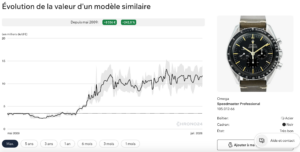
Reference 105.012 is the exact watch worn by Neil Armstrong and Buzz Aldrin during their first steps on the Moon.
The chart shows a very long period of consolidation around the €3,000–€4,000 mark until 2015–2016, followed by a spectacular rise in value once the market realised the rarity of Caliber 321 models in good condition. Now stabilised at around €10,000–€12,000, demand for this iconic model continues to grow.
Note the resilience of these price trends : despite the overall corrections in the watch market following 2022, iconic 321-caliber models have maintained high price levels. This is mainly due to the rarity of Speedmaster 321s, particularly when they are in very good original condition.
Its successor (ref. 145.012), also fitted with the caliber 321, follows the same trend but remains slightly more affordable than the 105.012. Expect to pay between €9,000 and €11,000 for a fine example. It is therefore the ideal choice if you’re looking to treat yourself to a Speedmaster 321 for under the symbolic €10,000 mark.
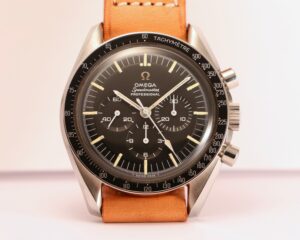
It is worth noting that a model fitted with its original steel bracelet (ref. 1506 or 1039) is generally valued at between €1,500 and €2,500 more than a version on a leather strap.
The Speedmaster 105.003 (« Ed White »)
1964–1969, straight lugs, caliber 321.
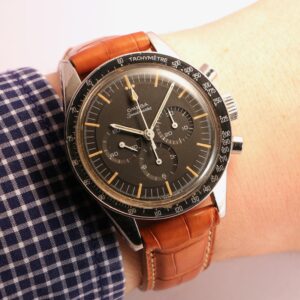
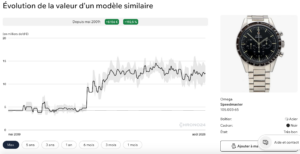
Worn by Ed White during the first American spacewalk in 1965, the 105.003 is the last model with straight lugs and no crown guard. The graph shows a trend similar to that of the 105.012 : a sharp rise from 2015 to 2017, quadrupling in value compared with 2009 to reach an average price of between €11,000 and €14,000.
The Speedmaster CK 2998
1959–1963, « Alpha » hands, caliber 321, a highly sought-after collector’s item (€20,000 and over).
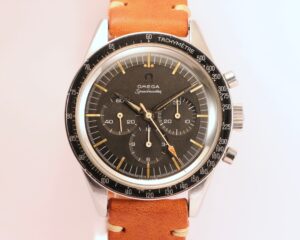
Analysing the 2998 model as a whole is more complicated, as there are significant variations in value depending on the production period and condition. For example, a 2998-1 or -2 with its original « base 1000 » bezel will fetch between €25,000 and €50,000, whilst a later 2998 will sell for around €20,000.
Below are two charts illustrating the 2998-1 (first generation) and the 2998-6 (latest generation).
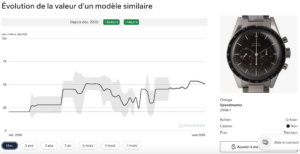
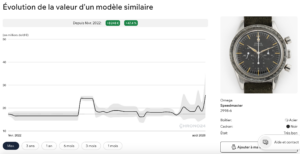
Prices for the most common 2998 models (from the 2998-3 onwards) are relatively stable, ranging from €17,000 to €25,000. This demonstrates the maturity of the market : exceptional pieces such as the CK 2998 still represent excellent buying opportunities for a long-term investment.
Why does the Speedmaster increase in value over time ?
There are several underlying factors behind this steady rise :
- A physically limited supply : Vintage Speedmasters (and the 321 models in particular) are becoming increasingly rare. It is also worth noting that most of the finest examples are carefully preserved in private collections and rarely appear on the market.
- The steady rise in prices for new watches : Omega regularly revises the retail price of the modern Speedmaster Moonwatch (now over €8,000). This increase naturally drives up prices in the second-hand and vintage markets.
- The patina effect : Collectors particularly appreciate the golden patina of tritium, which cannot be reproduced artificially.
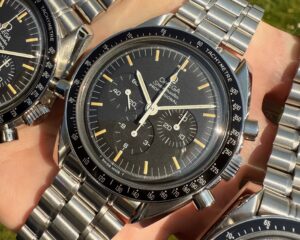
In conclusion: Which Speedmaster should you choose today ?
Whether you’re looking for your first collector’s watch or want to diversify your watch investments whilst treating yourself :
- Budget < €5,000 : Look out for reference 3590.50 or 145.022 from the 1980s and 1990s : beautiful watches, steeped in history, with very healthy potential for appreciation.
- Budget between €5,000 and €9,000 : A first-generation 145.022 (-68 or -69) is an excellent choice, thanks to its « step » dial which gives it a similar look to the 321 models.
- Budget > €9,000 : Look for 321-caliber models such as the 105.012, 145.012 or 105.003, true heritage icons of Swiss watchmaking.
At Brussels Vintage Watches, we carefully select each watch to ensure its authenticity, its original condition and its appeal to collectors. Please do not hesitate to contact us if you are looking for a high-quality timepiece.